FEATURED APPLICATIONS / PROTEIN-RICH BEVERAGES · FOODS WITH PARTICULATES · HEAT-SENSITIVE LIQUIDSS
Non-contact IEF Heating for Various Liquid Foods
Processing protein-rich beverages, particulate-containing foods, and heat-sensitive liquids requires careful control of microbial number, temperature curves, and product quality.
BioMag’s induced electric field (IEF) technology generates heat directly within the product without electrodes in contact with the food. From neutral-pH protein beverages and liquid whole egg to fruit juices containing suspended fruit pieces, IEF systems can be configured for continuous-flow heating, pasteurization, and sterilization processes.
Processing conditions are tailored to each product’s composition, flow properties, and microbial safety requirements.
What processing temperatures and treatment times can IEF systems achieve?
IEF technology is particularly well suited for neutral-pH protein beverages, liquid whole egg, heat-sensitive fruit juices, and foods containing solid particulates.
Its electrode-free design eliminates direct contact between heating electrodes and the product and helps maintain product quality. As a result, there is no electrode-related fouling. Depending on the application, this may also allow long intervals between CIP cycles.
What processing temperatures and treatment times can IEF systems achieve?
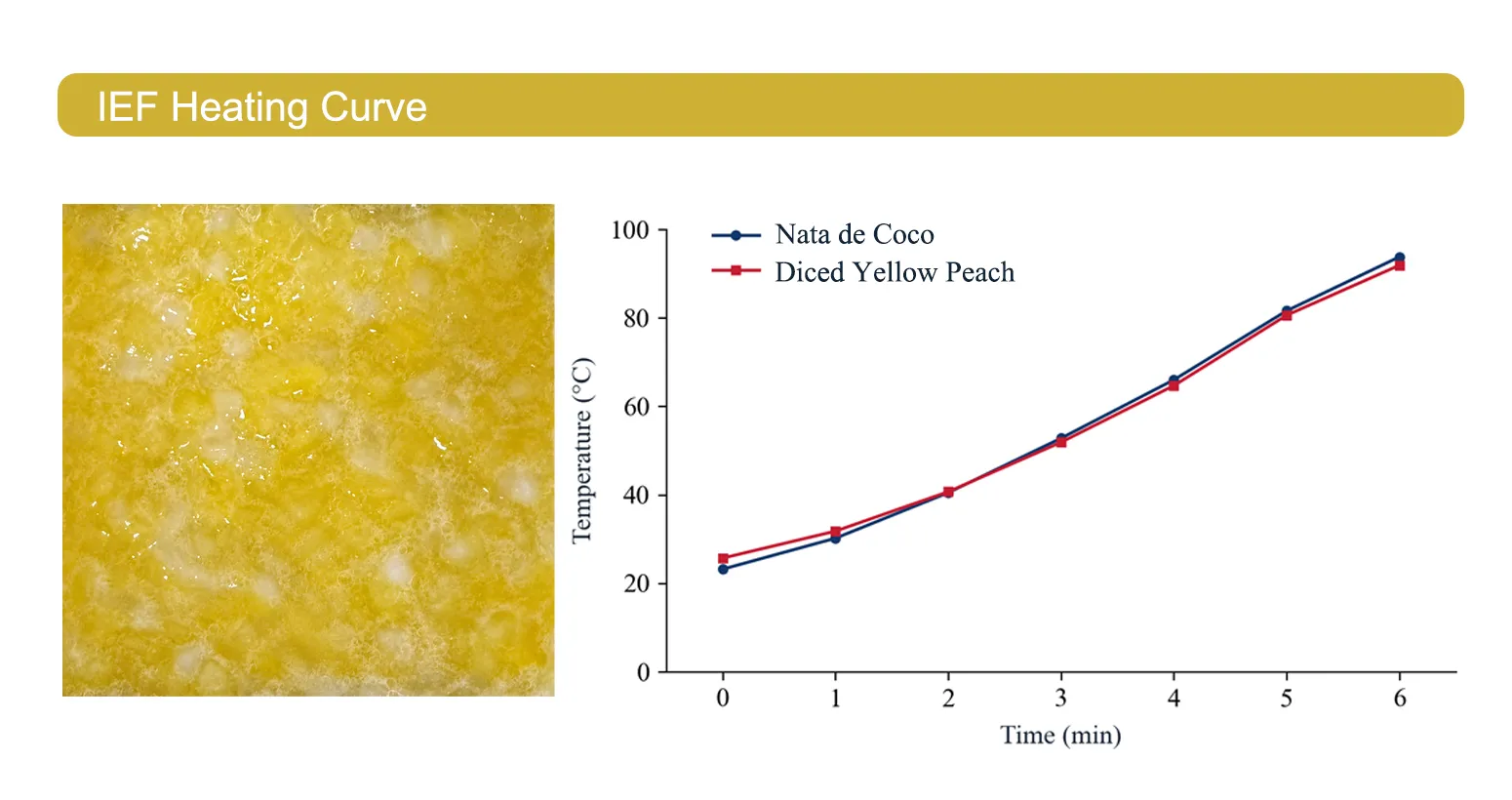
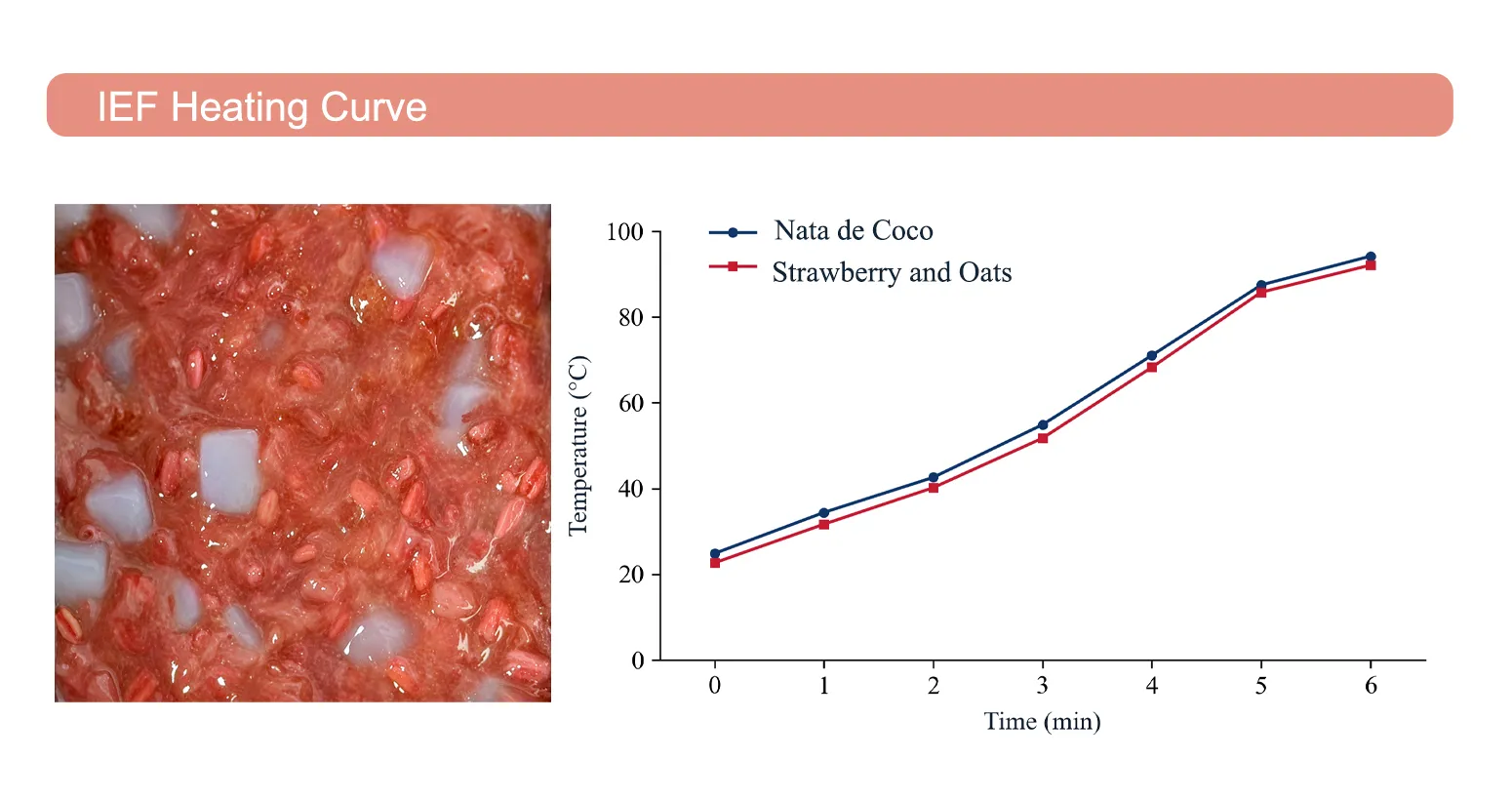
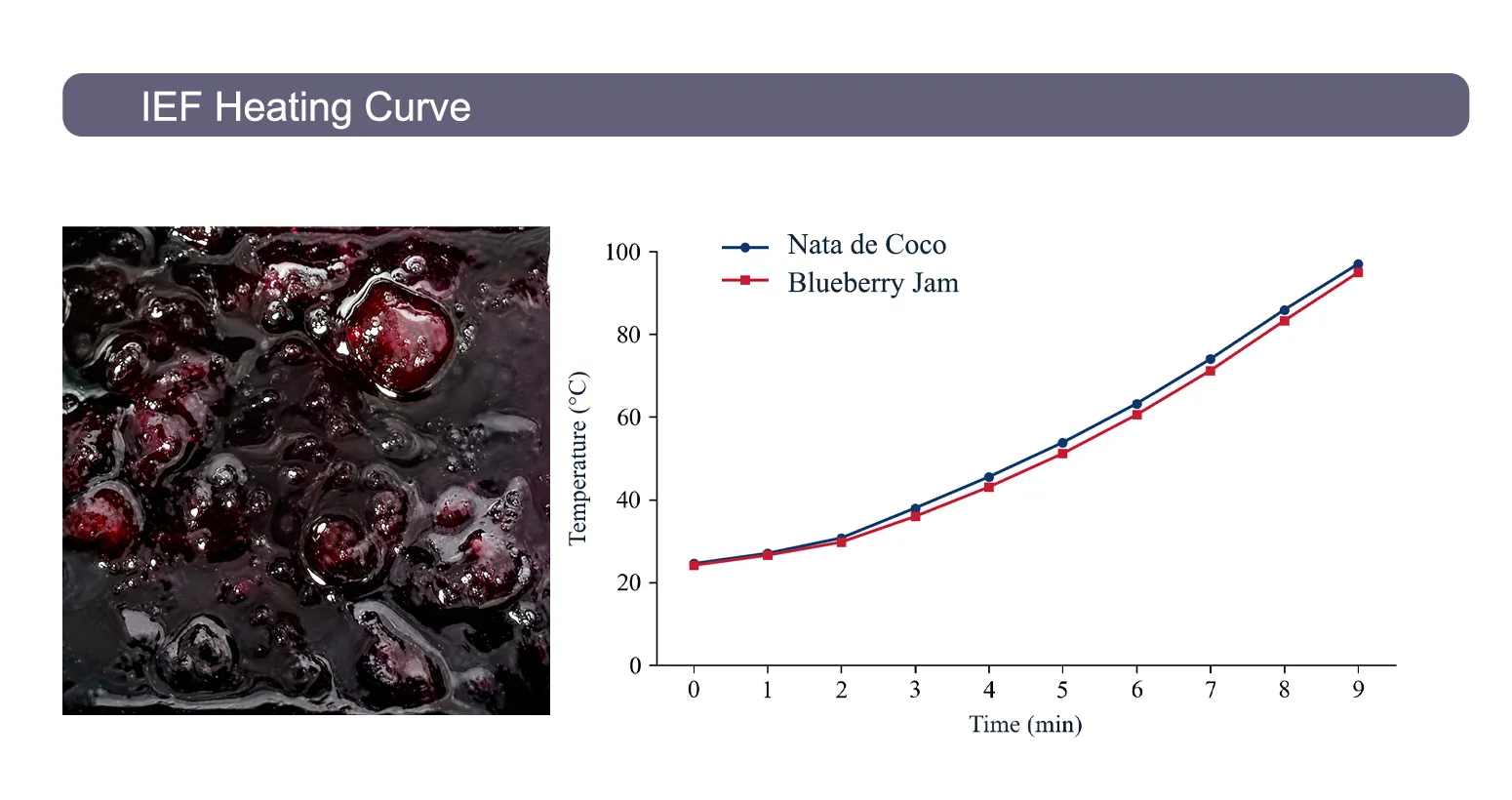
IEF systems can be configured for a range of thermal processing conditions. Thermal and nonthermal effects can occur simultaneously in IEF food processing. Representative temperature ranges for process development include: Acidic fruit and vegetable juices: 60–80 °C Protein-rich beverages and liquid whole egg: 60–70 °C Dairy products, particulate-containing foods, and jams: 95–121 °C For example, a process-development protocol may include approximately 2 minutes of heating followed by 3 minutes of holding.
These ranges are illustrative rather than validated processing recommendations. Final temperature and residence-time requirements must be established for each product based on its properties, target microorganisms, and applicable food safety standards.
What types of food products are best suited for IEF processing?
IEF technology is particularly well suited for neutral-pH protein beverages, liquid whole egg, heat-sensitive fruit juices, and foods containing solid particulates.
Its electrode-free design eliminates direct contact between heating electrodes and the product and helps maintain product quality. As a result, there is no electrode-related fouling. Depending on the application, this may also allow long intervals between CIP cycles.
How uniform and energy-efficient is IEF heating?
IEF technology enables heating of both the liquid phase and suspended solid particles within the same processing zone.
Under selected operating conditions, temperature differences between 20-mm particles and the surrounding liquid can remain within ±1 °C.
In pilot-scale and industrial configurations, thermal efficiency may exceed 85% without heat recovery and 95% when heat recovery is included, depending on the operating conditions and efficiency calculation method.
Actual heating uniformity and energy performance depend on product properties, system design, and operating parameters.
Can IEF systems be customized for specific food processing applications?
Yes. BioMag offers customized IEF systems and OEM/ODM solutions tailored to specific products and production requirements.
Systems can be configured based on processing capacity, product conductivity, viscosity, particle content, target temperature, operating pressure, and residence time.
Both the maximum allowable particle size and the processing tube’s inner diameter can be customized to meet specific product and processing requirements, subject to engineering evaluation.
Customization options include heating-section geometry, flow-path design, process controls, and integration with existing production lines.
Is BioMag's technology patent-pending, and will manufacturing licenses be available?
BioMag’s electrode-free induction technology is supported by an international portfolio of patent applications. We plan to explore technology licensing and authorized manufacturing partnerships with qualified equipment manufacturers and OEM partners, subject to mutually agreed terms.
Selected Patent Applications: EP 26174940.2 · US 2026/0223258 A1 · JP 2026-100642 · US 2025/0244290 A1
Chemical Reactions & Processing
What types of chemical reactions can the IEF heating reactor support?
The IEF heating reactor is designed for applications including polymerization, chemical synthesis, hydrolysis, extraction, precipitation, and crystallization.
Using non-contact IEF heating technology, the reactor generates Joule heat directly within conductive reaction medium, reducing reliance on heat transfer through reactor walls.
The platform can be configured for laboratory research, process development, and continuous-flow chemical reaction.
How does IEF heating differ from conventional reactor heating?
IEF heating technology uses time-varying magnetic fields to induce electric fields and induced currents within the reaction medium. These induced currents generate Joule effect.
There is no indirect heat transfer and provides an alternative method for controlling thermal treatment.
Heating performance depends on sample conductivity, magnetic circuit design, and operating parameters.
In the low-frequency range, the chemical reaction based on IEF heating exhibits significant non-thermal effects, and the frequency can be adjusted over a wide range, resulting in more diverse reaction performances.
Can the IEF heating reactor be customized for different processing requirements?
Yes. BioMag offers customized reactor configurations and OEM/ODM solutions based on processing capacity, temperature, pressure, residence time, and material properties.
Depending on the configuration, reactor systems can be designed for operating temperatures up to 220 °C and pressures up to 25 bar.
Final equipment specifications, operating limits, and integration requirements are determined during the engineering review process.